


Retirement insurance needs to get its groove back.1
The TikTok handle @ourvillageslifestyle provides occasionally viral videos of septuagenarians getting freaky on the dance floors of Florida. They dance like no one is watching their lusty retirements. That’s in part because America has quietly run one of the largest financial experiments in world history to test a simple thesis: can the stock market bear the weight of funding old age for the masses?
So far, so good. Typical retirees today are worth over $400,000, four times those of the 1980s even adjusting for inflation.2 That money is funding the sultry seaside parties where grandma reminds everyone that she’s still got it.
If we stopped time right now, President George W. Bush’s thwarted effort to privatize Social Security in 2005, mocked as moronic after the Great Financial Crisis, appears in hindsight borderline brilliant. After the idea died in Congress, the stock market beat inflation by over 7%. Meanwhile, Social Security for median earners has a real internal rate of return of barely 3%.3 Our nation of amateur portfolio managers have good reason to “feel the rhythm of the music get-ting-stron-ger.”
But what happens if the music stops?
The Forever Paycheck
A growing fear among Baby Boomers and the Generations who hate them is that this conga line might not go forever. We’re rich, but anxious. Pensions gone. Social Security broke. Generations sandwiched. It feels like we need a hero to come out of retirement, squeeze into that super-suit, and save our retirement future.
That hero has a name: Annuities.
Like Pops partying on the dance floor, this seemingly boring insurance product, which transfers savings into a lifelong paycheck, is overdue for a comeback.
Or, perhaps, it is more a coming out of the closet. It may be lost on Gen Z, but saying nice things about annuities is every bit as controversial in finance as a same-sex kiss was 30 years ago when Ellen did it. It is, in the words of a new book, verboten.
Enter that book, Jean Chatzky’s The Forever Paycheck. Chatzky’s resume in financial journalism is long: financial editor for the Today Show, editor at Money, writer at Forbes; she is a veritable institution to herself. HerMoney, which she founded in 2018, is among the largest female-focused financial media brands in the world. She’s been on, well, just name a big show, she’s appeared on all of them.

Few will notice why the book is so controversial. The thesis is simple. The details, which she goes to great lengths to make relatable, are still about insurance and thus, well, very much like talking about insurance.
But as Chatzky explains, coming out of the closet for annuities is surprising even to her. When a financial advisor suggested annuities for her aging mother, she curtly informed him they would do no such thing. EVERYONE in personal finance by the late 1990s knew why.
Annuities were not heroes, but villains. They stole from the naive and gave to the savvy, a reverse Robinhood product.
Do you know how hard it is to get Dave Ramsey, who has no debt, and Robert Kiyosaki, who is over $1 billion in debt, to agree?
But they both hate annuities.
So why did Chatzky change her mind?
And is she changing mine?
A Risqué History of Insurance
Though forms existed back to Hammurabi’s Babylon, insurance as we know it today started out as an Italian joke, taking bets on which ships at sea wouldn’t make it back to Venice. Coffee shops in London eventually kept tallies of wagers on a board, a 17th century dead pool. You could bet on celebrity lifespans, the first name of Louis XV’s next mistress, or the true gender of the androgynous French diplomat Charles de Beaumont. Insurance used to be fun.

It was also very useful. By placing a bet against yourself (my ship will sink), you sold your risk to the other bettor. If things went wrong (it sank), the losing bet paid you, offsetting your losses (You sunk my Battleship! Oh, look, money!!!). Survive, and you’d lost the bet but won the game. An industry born betting on bad luck and bawdy jokes became a way to handle risky behavior.
Insurance was red hot in the nineteenth century. First fire, then disability, death (ironically called life), even losing your job became something you could insure against. There was insurance for horses, plate glass windows, and oil lamps. You could insure against getting married, where bachelors spent $8 a year ($265 today) against the risk of falling in love and needing starter funds for wedded life. Throughout the late nineteenth century, Americans were crazy for insurance.
And then there was retirement. Today, retirement savings and wealth building are treated like two halves of a whole. That is entirely new.
In the past, saving for retirement was a version of an emergency fund: “Oh, crap, I didn’t die. Now what?”
Enter tontines, essentially death pools, but where people risked together. Everyone pays in, and the longer you live the more you get. Losers don’t care about losses (they’re dead) and the elderly get cared for. By the turn of the twentieth century, 2/3 of American life insurance policies worked this way. They were, in essence, an emergency fund for the very real crisis of living too long.
Insurance became Americans favorite way to save and invest before the Great Depression. The industry’s most popular product, cash-value plans, were originally a brilliant innovation born of fierce competition. In a world where savings was easily lost to financial panics and workplace death occurred a whopping 50x more than today, combining insurance with cash savings solved two problems at once. Insurers stored up portions of premiums as savings plans. When plans expired, if you had not died, you could get a portion (and eventually all) of your money back. It was like the prize at the bottom of the life insurance box. Congrats on not dying! Here’s cash.
In the meantime, many families borrowed against that cash to buy homes, fund weddings, and live life. Cash value plans and annuities dominated families’ financial strategies, second only to real estate, for most of American history. Americans would literally skip meals to avoid forfeiting their insurance policies.
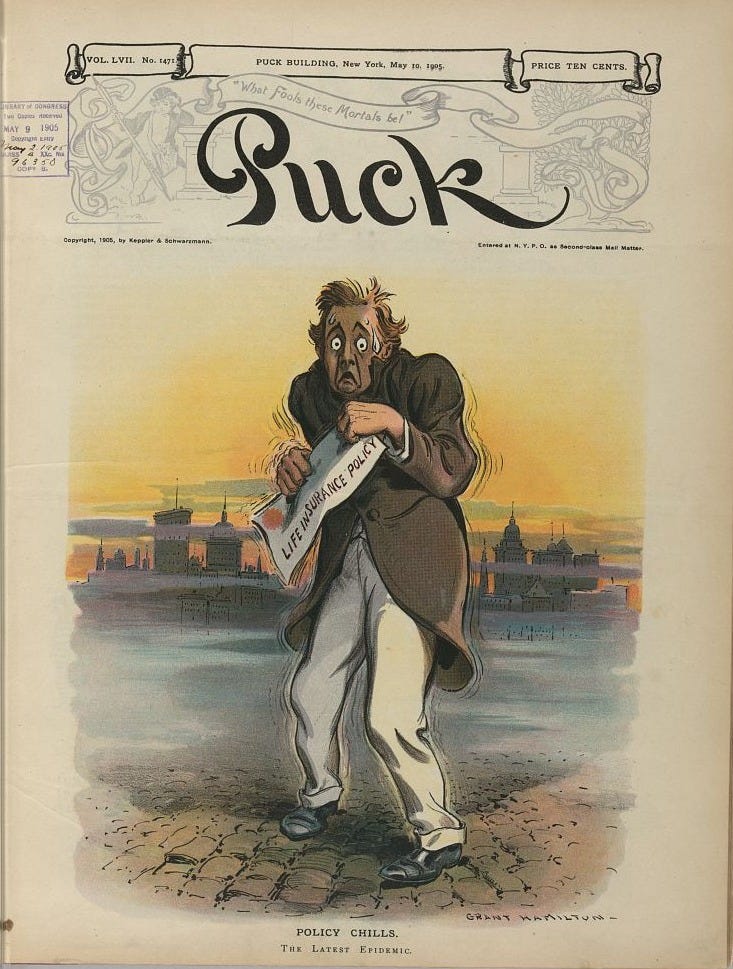
As late as 1952, when the Today Show, MAD Magazine, and CheezWhiz all debuted, just 6.5 million US citizens owned stocks. Another 53 million had savings accounts. But there were 104 million insurance policies, enough for every adult in the nation.4
All those premium payments had to go somewhere. At their peak, insurance companies held. . .
(and you really should take a breath before you read this next part)
. . . assets valued at 37% of Gross Domestic Product.
One third of the American economy was owned by insurance companies: farms, mortgages on those farms, stocks, bonds, skyscrapers. If it reliably made money, an insurance company probably held the title.
That is why there are no Christmas movies about crowds running to get their money out of life insurance companies on their way to the old Building and Loan. In the early 1930s, 40% of all banks failed (over 10,000). In that same Depression, just 19 insurers went under with losses of barely $1 million: 0.0007% of total industry assets.
Nothing super safe stays sexy for long: it loses appeal. One hundred years ago people spoke openly to family and friends about “the duty to insure.” No longer. The once ubiquitous insurance agents that blanked the nation were replaced with ads begging us to get protected from mayhem or trust a good neighbor. We must be entertained, or terrified, to even ponder insurance these days. As an asset class, household balance sheets make insurance an afterthought. American families today hold more money in savings accounts than the value of their insurance policies. That stat would have been unthinkable a century ago.
What happened?
The tide turned in the 1960s-70s. As inflation surged, insurance didn’t keep up. Suddenly, the policy’s cash “value” was denominated in dollars from twenty years ago. The value of old annuities in many cases became barely 75% of their old purchasing power, and sometimes less.
Nearly every popular financial guru in America turned against insurance in favor of stocks, bonds, or real estate: Sylvia Porter (1960s), Venita Van Caspel (1970s), Charles Givens (1980s), Suze Orman (1990s), and Dave Ramsey (2000s) agreed on very little about personal finance except the foolishness of cash value policies and annuities. In a world where the average person could buy into a stock market that went up and up, one best-selling finance book explained in 1980, “Insurance is for dying. Investments are for living.”
Retirement saving was no longer an emergency plan. It was a path to prosperity. Insurance was no longer fit to purpose.
Greed hurt too. Insurers faltered in part because they lost the hard-won reverence of families for solving their needs. No one doubted companies made profit, but families increasingly found that salesmen “recoiled in horror” as one Reagan era housewife recalled, when they suggested buying a simpler, less profitable plan. He was selling, she realized, the best policy for his wife and children. Everyone in finance had a story (many still do) of a foolish family member sinking their entire savings into a grotesquely high fee, penalty-if-you-pull-out, variable annuity that underperformed a savings account. Things got so bad, and the industry so slimy, that even insurance salesman wanted to escape the stink. They banded together in 1969 to become “Financial Planners.”
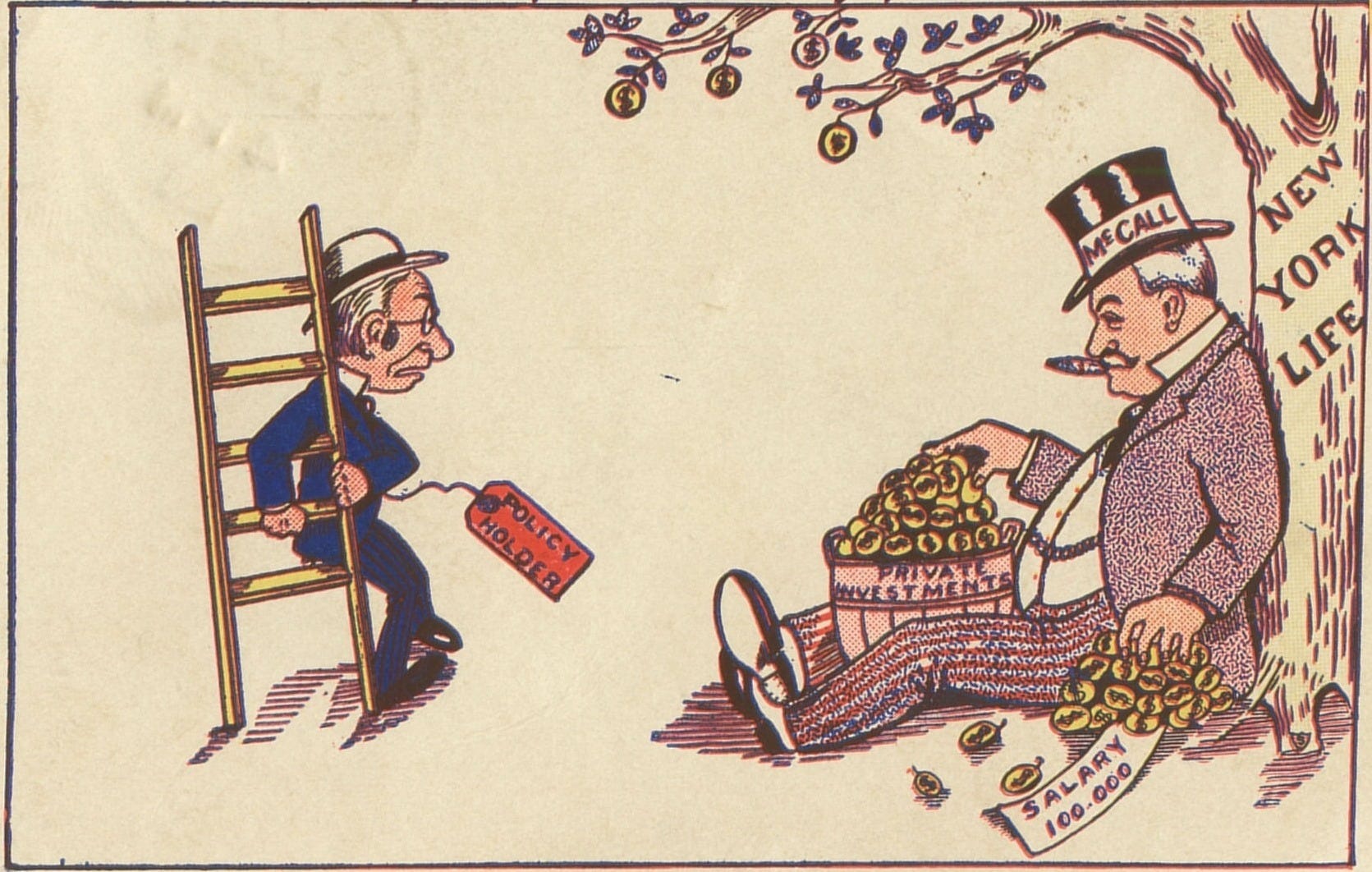
Frankly, Monsieur Insurance Company, we don’t trust you anymore. You stopped paying attention to OUR needs! So, we started getting frisky with someone else, Mr. Market. He may be volatile, but we always know where we stand.
And, OMG!, AMAZING in the spreadsheets.
Getting Back With Your (Financial) Ex
That may be about to change. Boring is bad. Boring and sleazy is worse. The insurance industry, slowly, took notice. In 2018, the nation’s largest insurers began a non-profit marketing push, “The Alliance for Lifetime Income,” to fix their image. It was mostly a PR gig. But it also involved simplifying offerings and becoming (somewhat) more transparent about fees. The NAIC, a coalition of government regulators, pushed through a “best interest” of the customer standard for insurance sales that took effect in 2020. And, crucially, it is now possible to get low-fee annuities. Just as they did for stocks, Vanguard, Fidelity, and Schwab entered with dramatically lower fees than traditional players. They now offer annuities with fees lower than most mutual funds.5 Insurance may not have gotten its act together completely, but it is making the effort. And, as exciting as Mr. Market is, he is manic. There is something alluring in stability.
This is a moment for the insurance industry to rekindle that old appeal if it can do what it once did and solve a real problem for American families: secure our yet untested DIY retirement system.
Remember how we got here. Insurance isn’t really something you buy. Like the name of the monarch’s future side-chick, it is a bet you make. You are taking the risks of life—whether forgetting to turn off the curling iron or running out of time to show off that new hip—and auctioning it to Allstate. You don’t buy insurance. You sell risk.
And risk is in the air right now. Society turned the stock market into a retirement vehicle for the masses but never stopped to notice an important detail: that is not what the market was originally built to do.
Wall Street was designed to allocate capital. The promised abundance of a rising market lifting all retirement boats is increasingly dependent on the rising part. When water stops flooding in, then what?
Insurance companies can buy Americans’ retirement risks, and at our societal age that is an increasingly appealing trait in a (legal) person.
(who doesn’t love a good Citizens United joke?)
Annuities are functionally self-purchased pensions. They lock in a modest retirement that won’t depend on the market’s meteoric rise to the moon. How? Insurance companies own a vast array of assets beyond stocks: mortgages, timber, farm land, private firms, loans and, crucially, hedges against market declines. Big, diversified, old money wealth has a certain appeal that average Joe stock-trader can’t compete with.
Plus, the average Jane … and apparently Jean … are changing. As Americans have ever fewer children to leave inheritance to, and as the cost of elder care increasingly falls on the few we have, we’re putting more and more of our eggs into the passive index fund nest. That’s risky, or as they said in early eras, risqué. Risqué is exactly how insurance companies can catch Americans’ eye again, by offering to buy our risk and offer more stable futures.
One of the lessons of history is that what “always worked” kept changing.
And that is why Chatzky’s take is that rare thing in finance literature: an important book saying something truly new . . . precisely because it understands the past. The Forever Paycheck doesn’t prescribe throwing your entire nest egg into annuities. You should not do that, and she says as much. Her recipe calls for adding just enough annuity cream (around 1/3 of your nest egg) to make up the difference between the thin sauce of Social Security and your retirement appetite. Keep the rest in a stock/bond portfolio to grow your principal and, as she rightly points out, you can then take bigger risks with the remaining principal since you’ve secured your base. Blind trust is for youthful romance. Mature thinkers never put all faith (or funds) in either Wall Street or Connecticut (fun fact: the state with the highest concentration of insurance companies in the Union).
This is a truly useful book, and if you’re trying to square the retirement circle, it provides a step-by-step guide worthy of your time that offers a clear action plan to make simple sense of a complex topic. She breaks down the wild array of product names and meanings clearly. The book is also very sharp on marital finances in the golden years.
My critiques are few. She walks right up to the line, but doesn’t quite bark out the play, to avoid variable annuities. I suspect this is an Ivy League educated journalist being measured. As a rural southerner raised with phrases like “well butter my butt and call me a biscuit,” I get to be less subtle. So, …
NEVER BUY A VARIABLE ANNUITY!!! Variable annuities are what would happen if a 401(k) ran off with a traveling salesman, had a baby, gave the baby up for adoption, and then made you pay the child support. The upside is theirs. The downside is yours. These only makes sense if you are already rich, and if you are already rich you need neither a forever paycheck nor my strongly worded opinions.
So, as I was saying, good book.
Chatzky calls on consumers to reconsider an old flame, because she realizes times changed.
Now it is time for insurance companies to show they’ve changed, too. Return to what made people love you in the past. Buy our risqué. Satisfy an urge Americans are just beginning to realize we have—breaking free of the barely tested DIY retirement system. Stocks were fun, but we’d like to settle down now.
Meet our needs, and we’ll swipe right. Treat Americans not as a high-fee, one-night stand but like a safe, reliable partner.
If they do, it might make insurance sexy again.
This essay, using the “make it sexy, again” theme, was originally written in early 2026. I showed it to Jean Chatzky after I was a guest on the HerMoney Podcast. She replied, essentially, “I’m writing a book about that!” I was excited that someone else was thinking in this vein, and waited to publish it until her book released in September. Jean helpfully suggested the metaphor of a trusted partner and not just someone to “Swipe right” on. I’m grateful for her feedback.
According to the Federal Reserve’s Survey of Consumer Finances,
According to the Social Security Administration’s Actuarial notes of 2025. Returns are slightly better for the poor, but overall pale in comparison to Wall Street’s epic run. Had billions more flowed into stocks via Social Security deposits, the gap would likely be wider still.
Janice M. Traflet, A Nation of Small Share-Holders: Marketing Wall Street After World War II (Baltimore: Johns Hopkins University Press, 2013), 75.
It appears Vanguard no longer offers theirs.
Love this history lesson! I saw Jean speak on Friday and she made absolutely me rethink my hatred of annuities as well. The balanced approach she recommended was refreshing