


There was a moment around 2024 when I nearly gave up. I won’t go into all the reasons, but it wasn’t looking good.
For a decade, I had a bee in my bonnet that no history of everyday Americans and their money existed. Did they get ahead (yes) and how (long story)?
But I was the ONLY person who thought this mattered. Naively, I approached 5 of the top literary agents in the country, assuming I would pick between them.
90 Nos later….
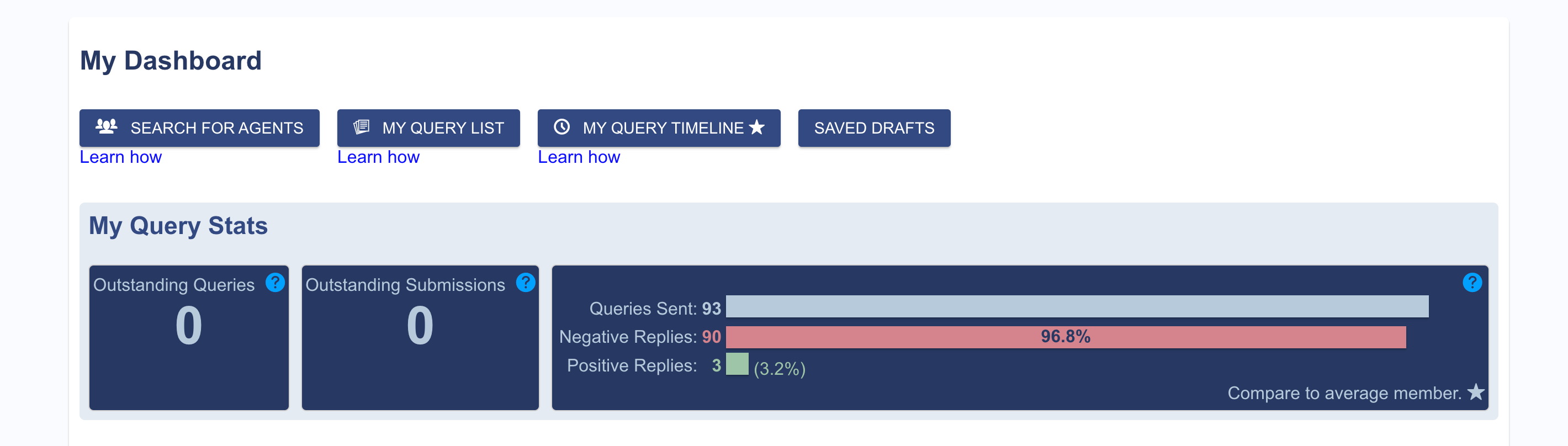
That’s my QueryTracker Dashboard, the system authors use to get an agent.
85 rejections/no-replies. Just 8 showed interest. Five then rejected the proposal itself. Another mostly sold soft-core cowboy erotica, but said he could try.
And then, an email came from a successful veteran agent who saw what I saw…
Here was a history that could help people, a story never told on a topic everyone cared about. He was ready to sign me that day. This was November, 2024….
This is today:
Publisher’s Weekly and USA Today National Bestseller Lists
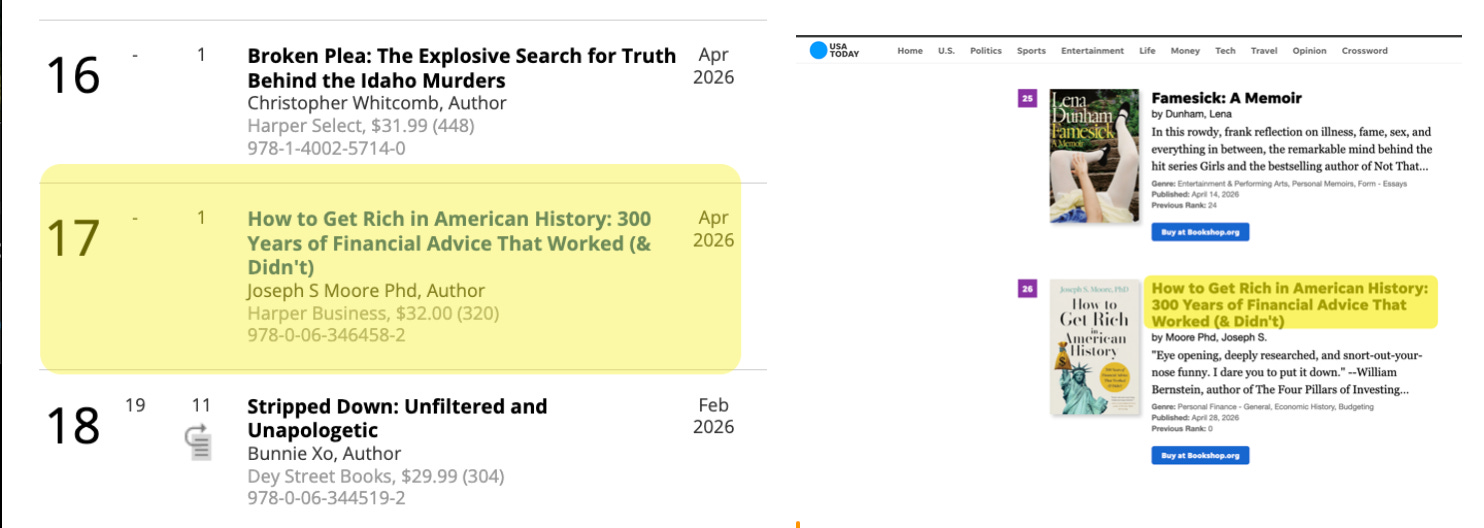
I’ve had about 48 hours to absorb the news that How to Get Rich in American History hit two national bestseller lists, #17 on Publisher’s Weekly and #26 in USA Today.
Since I mostly write optimistic histories about everyday people getting ahead, I thought I should write an optimistic history of me getting ahead, and how other writers can, too.
Here, as best as I can tell, are my lessons learned.

1) Believe (in the project)
You must believe, to your core, that this needs to be said.
People say they “want to be a writer.” My question is, “about what?” You have to believe in the message more than the messenger.
Great writing is about readers and stories. Your job is to bring them together. Writing is matchmaking. You must believe these two just have to meet each other.
The logic said to give up at rejection number 9, 19, or thereafter.
I just… believed.
Also,
market test. Don’t tell people your ideas. Tell them your stories. Do they laugh/cry/ask for more or do they change the subject? Books are read by everyday people, intermediated by agents-editors-publishers-show bookers-hosts. You’re going to have to get those intermediate people’s buy in, but in the end readers decide if the next page is worth the turn. You’ll see it in their eyes. Remember, the order goes hear about-buy-read, in that order.
lean on the people who believe in you. It helps to have at least one.
2) “No” is a feedback mechanism. Respond to it.
“No” ≠ “never,” it means something isn’t working. The question is not, “should I quit?” but “should I change and how?”
Either:
Your title sucks: a great idea poorly packaged is the same as a bad idea. Apparently “Financial Advice in History” translates as “Delete.” Agents can sell a mediocre writer with a great title easier than a great writer with a bad one. Someone said “There is a reason it’s called the best-seller list, not best-written list.” You need a hook.
You have a great idea that doesn’t need to be a book. Books require the reader to spend 2 things: 1) money, and 2) time (8 hours on average). Your idea might be worth neither $32 nor a full work day. Some ideas need to be articles, essays, or posts. Frankly, your idea may go farther, faster on social media than waiting years for shelf space.
You don’t have a great (or new) idea, after all. Hard to swallow, sometimes true. When Morgan Housel published The Psychology of Money, I spent a very lonely night asking myself if I was done. Ultimately, I decided I had something different to say (conclusions, topics, and buying land on the moon). But it was a close call. Ask yourself, “is this a vanity exercise?” When in doubt, return to lesson #1.
You have a great idea, title, book… but no followers. This makes me mad. The new truth in publishing is you bring buyers with you. The first thing agents/editors do is look you up. They ask not “can you write?” but “can you sell?” I happily logged off years ago. So:
fake it till you make it: I had the good sense after 20 or so “nos” to get myself a website, good photos, and visibility to my previous stuff. Highlight what they care about, not what you care about. My first academic book sold maybe 200 copies, but was reviewed as “often-witty.” I put that everywhere.
good news: Influencers have a bad habit of caring mostly about being influencers, not selling out advances. Come up with a plan for how you will relentlessly sell this book to convince the press they can trust you on other people’s media. Put this in your proposal.
Also,
your query letter quality matters. A good guide is here
your book proposal matters even more. I went away to a mountain cabin for a week to write mine. A good guide is here
there are no rewards for humility. Tell them how great you and your ideas are.
take NONE of this personally. If you were an agent, you would say “No” a lot, too.
3) Your book is a business. Run it that way.
Writers feel icky about selling. But you are a small business now (Writer, Inc.) and your book is a product. Think entrepreneurially.
You will not DIY the bridge to the promised land unless you already have 1 million followers. You’ve read this far. You do not have 1 million followers.
It is EASY to sell 10 books. You have friends.
It is DOABLE to sell 100 books. Your network has dry tinder.
It is EVEREST-like to sell 1,000 books. People are sick by your 3rd Facebook post. Welcome to “the market.”
You need a small percentage of a huge number, not a large percentage of your friends
You need partners (carefully chosen).
Agents can teach you how this market works. Listen. Learn.
Editors know how books get read. Listen. Learn.
PR people know how hard attention is to grab. Listen. Learn.
Be a good partner. Ask everyone what they need from you, then do that! If they ask for you to write an op-ed, turn it around ASAP. If they get you on a tiny podcast with 4 subscribers, show up early & prepared.
Remember, they have other clients and books. You can’t just sit passively waiting for them to bring success to you. Agents/editors/marketing/PR want authors willing to email every person they once met at a conference.
After every interview, large and small, follow up. Be grateful to every person who has you on their show.
Make new friends! You’ve been ushered into a party of some of the world’s most interesting people. I’ve started at least 3 new acquaintance-ships/friendships going through this process because these guys are just super cool/quick/funny/smart.
Also,
people take money from anxious authors. I paid for ads generating no sales, got emails from “famous authors” (scams), and fielded dozens of “book clubs” that for a “small fee” will “feature” you. Scare quotes everywhere. Vet everyone.
most writers don’t live off writing. You need a business plan to turn your ideas into income: speaking, subscriptions, a fortunate marriage. I had the great luck of getting rich from my research. Don’t plan on that.
You have to spend money to make money. You do not have to set it on fire.
4) The death of the gatekeepers was greatly exaggerated
I will go anywhere to talk to anyone. That doesn’t move books. What does?
Traditional media.
This is not 2018 anymore. People have gotten numb to “my next guest has a fascinating new book.” Think about your own podcast feed. Do you buy books after every listen? Why should they?
Podcasts build brand awareness. It says, “this is what I’m about.” If they like you, they find and follow you.
A few weeks before launch, my book was going nowhere. All those interviews were for naught. Then, out of nowhere, I started zooming up Amazon charts for seemingly no reason. It started Friday. I checked obsessively like Notre Dame was playing football but I was out shopping with my wife. We scored again! The shoes look great.
By Sunday, I was #1 New Release in Personal Finance, #3 overall in Economic History, and #7 in Finance. I had no idea why.
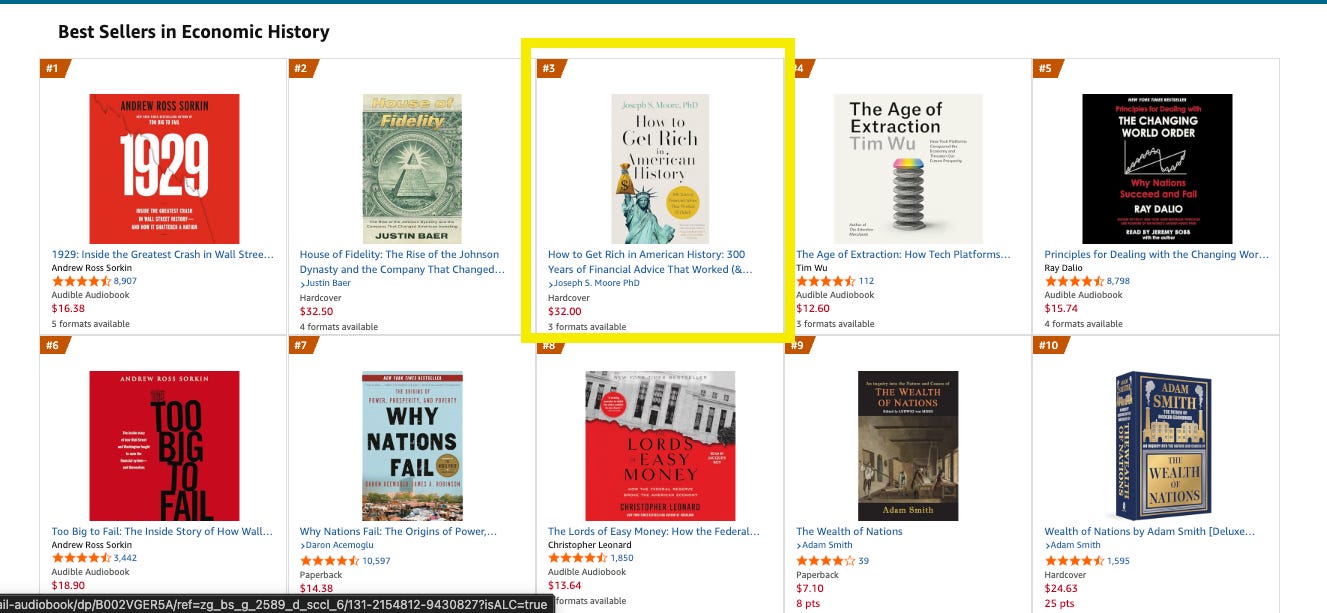
It was Bloomberg. The press sent out copies of the book, and their Personal Finance section did a review:

Short interviews on tv, radio, and newspapers spiked sales more than many podcasts combined. The legacy media is alive and well.
Also,
Show bookers don’t care about your book. They care about the interview. You need to work at being a great guest. I carry 40 flashcards in my pocket like I am an undergrad prepping for an exam.
It is okay to start small. The top media bookers cannot risk having you “ummm, like, uhhhh” on national TV. They could lose their job over you! Prove yourself. You are not too good for “Wake up with Wendy” at 5am in Tulsa.
5) Borrow Credibility
As soon as you sign the contract, you get to spend the publisher’s street cred. It’s not little-old-you emailing, its a Big Name Press author.
I call this success-stacking, and it is how I’ve gone from a tiny junior college in the South living in a rotted out trailer to whatever you call where I am now. Take one tiny win, make it sound as big as possible, and use it to grab another two. Now you have 3 wins. Make them sound as big as possible. Rinse-Repeat.
Borrow credibility. Stack success. Once you have your own, lend generously.
Also,
on the “self-publish vs. traditional” debate: media bookers are drowning, DROWNING in book pitches. I have a friend with a decent sized podcast. He gets 10 pitches every … single … day! Traditional publishers are social proof. You need them.
Seth Godin says there are “knock-knock” books. Once audiences hear the joke, why buy the book? Interviews are exercises in entertainment. Be fun. Leave them wanting more.
6) Soak it in.
This book was supposed to flop, and I knew it. We missed many media targets. The Bloomberg spike, plus the evangelical force of my mother and mother-in-law flooding the earth with the good news, meant by launch week we had sold out at Amazon, Barnes & Noble, Books-a-million, etc. I was going on tv to sell a book nobody could buy from an author no one ever heard of.
Then, my brother called.
My baby brother played college and pro baseball. He was good, but couldn’t stay healthy. Finally, with a heart to play forever, an arm that could still pitch, but a shoulder that wouldn’t quite put the ball where he wanted it to go, he retired to become a CPA.
I was about to fly to New York. He said roughly this:
“For the rest of your life, people will want to talk about how far you went.
But all you’ll think about is how close you got, but missed.
I was standing on a mound, in front of thousands of fans in Joliet, IL, where a million men wished they could be. One day you walk off the grass, untie the cleats for the last time, and it hits you … I should have soaked it in.
Don’t tell me you didn’t get on Rogan. You got to do something really, really cool…
you wrote a book!”
I hung up. I’m 48 years old. Cried like a child.
I hit New York like a tornado. This thing was going to flop, and I was going to love every minute of it. New York Stock Exchange-NASDAQ-podcasts-dinners-conversations…
“Hi. We haven’t met but, …”
I even staked out The New York Times lobby hoping to give Andrew Ross Sorkin a copy.
And, in the background, the team delivered. It is a business, remember?
The publisher pushed inventory fast, PR opened doors, and all the media training meant I nailed interviews. I nearly flubbed one, but an amazing publicist sat me down for an hour and helped me find the right words.
Also,
not all sales count, which is weird. We sold over 1,000 copies to a library group that never registered for “bestseller” sales. You need to get educated on how that works so everything you do counts. Your publisher and agent can explain it better than I can.
Many authors describe launch day as depressing/anticlimactic. Ask friends/family to host an event so you have something to do rather than sitting at home checking your feed.
“Gratitude turns what you have into enough.”
I think Simon Sinek said that, but I’m too tired to check.
Publishing isn’t fair. You will be shocked 😲, shocked I tell you, to discover that most bestselling books are written by journalists already at major newspapers. If a book debuts to acclaim and immediately becomes a movie, check to see if the author’s mom just so happened to be high up at a major media outlet. This is the norm.
Don’t focus on it.
You are smart, well educated, and live in a society abundant enough to afford time to write. You probably have an ancestor who was smarter, less educated, with no such time. You probably aren’t the best possible writer in your family tree, just the first with a chance.
Use every advantage you have. Don’t resent the ones you lack.
Resentment doesn’t sell books anyway. Action does.
You get to act on the world with words. How cool is that?
Postscript
Nobody predicted this, and by the end even I gave up. Because of the logistics, and despite hurling every spare penny I had into getting this thing off the ground, I went to bed the night before lists published telling myself it wasn’t going to work out. I would be at peace. Stoic even. Seneca with a book for sale.
I did not sleep at all—getting up every 45 minutes or so to pace and check my phone.
Sometime around 5am I passed out. At 7:05 my wife called in tears. “We did it!”
As Ted Lasso, the great philosopher of informed optimism once said,
“To believe in yourself. To believe in one another. That’s fundamental to being alive… can’t nobody rip that apart.”

Buy the Book!

Order on: Amazon | Barnes & Noble | Bookshop.org | Books A Million
I think I'm going to start making this required reading for anyone who launches a book. Thanks for leaving this for those who come after you Joseph.
Congratulations Joseph!
And thank you for sharing your insights; a lot of your advice here is applicable to endeavors in many areas of life.